15. Electromagnetism
[accordions autoHeight='true']
[accordion title="1. Definitions"]
- The magnetic flux density at a point is defined as the force acting per unit current per unit length of the conductor when the conductor is placed at right angles to the field.
- One tesla is the uniform magnetic flux density which, acting normally to a long straight wire carrying a current of 1 ampere, causes a force per unit length of 1 N m–1 on the conductor.
- The following are the vector symbols used in diagrams to represent the direction of vectors in 3 dimensional space:
- $$\rightarrow$$ : on the plane of the page
- $$\otimes$$ : into of the page
- $$\odot$$ : out of the page
- The following are some important points to take note when representing a magnetic field by magnetic field lines:
- Magnetic field lines appear to originate from the north pole and end on the south pole.
- Magnetic field lines are smooth curves.
- Magnetic field lines never touch or cross.
- The strength of the magnetic field is indicated by the distance between the lines – closer lines mean a stronger field.
- When a wire of length $$l$$ carrying a current $$I$$ lies in a magnetic field of flux density $$B$$ and the angle between the current $$I$$ and the field lines $$B$$ is $$\theta$$, the magnitude of the force $$F$$ on the conductor is given by $$F = BIl sin \theta$$.
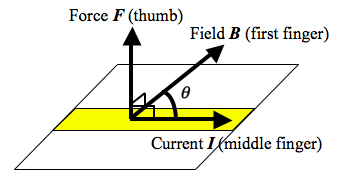
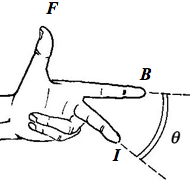
- The directions of the vectors can be recalled by using the Fleming's Left-Hand Rule.
- A charge $$q$$ travelling at constant speed $$v$$ at an angle $$theta$$ to a magnetic field of flux density $$B$$ experiences a force $$F = Bqv sin\theta$$.
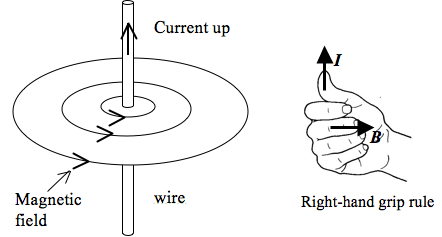
- Long straight wire
- Flat circular coil
- Solenoid
- Like currents attract and unlike currents repel.
Discussion
0 views •