IP4 12 DC Circuits

Hidden Circuits Interactive

I made this interactive tool using javascript for the teaching of DC circuits for integration with SLS as part of the IP4 Physics blended learning experience in the upcoming weeks.

The intention of this interactive is for students to do a preliminary inquiry activity to exercise what they learnt about series and parallel circuits. They can be tasked to draw out what they think the circuit diagram will be like, either on Nearpod or SLS.

Students can even notice the differences in brightness under different conditions. Questions can be designed around this as well.

Previously we used to construct little boxes with wires hidden underneath. However, due to wear and tear and with Covid-19’s safe management measures, a digital version that can be accessed via the students’ mobile devices is more suitable.

Light bulb image is adapted from Good Ware from www.flaticon.com
Switch image is adapted from Those Icons from www.flaticon.com

For a direct link to this interactive, please go to: https://www.physicslens.com/wp-content/uploads/2022/04/index.html (updated link)

To obtain the zip file for upload into SLS as an interactive media object, click here.
Internal Resistance and Maximum Power Theorem

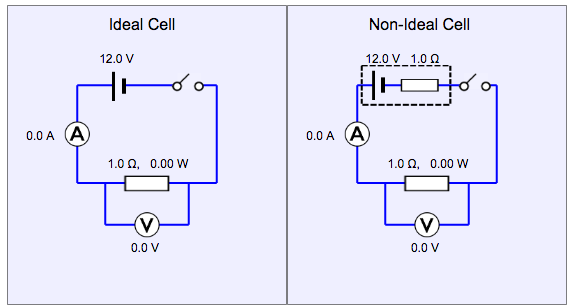
I’ve created this simulation to demonstrate the effect of an internal resistance due to a cell on the potential difference and current of an external load.

One can also vary the internal resistance and external resistance to observe the maximum power theorem. The theorem states that for a given finite internal resistance, one can obtain the maximum external power only when the resistance of the load is equal to the internal resistance of the source.

internalresistance

https://ejss.s3.ap-southeast-1.amazonaws.com/internalresistance_Simulation.xhtml

Introducing Delight! An Educational Board Game on Current Electricity

Delight - Physics board game on electricity

Download Now

Creative Commons License
Delight by Tan Seng Kwang is licensed under a Creative Commons Attribution-NonCommercial-ShareAlike 3.0 Unported License.

An educational board game for 2 or any even number of players (in 2 teams) based on the concepts of current electricity. Targeted at high school / junior college physics students, Delight is a fun way of practising the use of physics concepts such as

  1. electrical power $$P=\frac{V^2}{R}$$
  2. the potential divider rule.
  3. wires bypassing a device short-circuits it.

This game can be easily printed on A4 paper and the game pieces can be cut up for use.

Game Play

  1. This game is meant for 2 players or 2 teams of players. Each player/team has the following tiles:
    • 2 x light bulbs
    • 3 x T-shaped wires
    • 2 x crossed wires
  2. The players will take turns to place the tiles on the board.
  3. Each new tile must have at least one wire connected to an existing wire on the board.
  4. The game will end when the last tile has been placed on the board.
  5. The person with the brightest bulb will win.In the event that there is an equal number of opposing bulbs of the same brightness, it will be considered a tie. If there are three bulbs of the same brightness, the one with two of these bulbs wins.

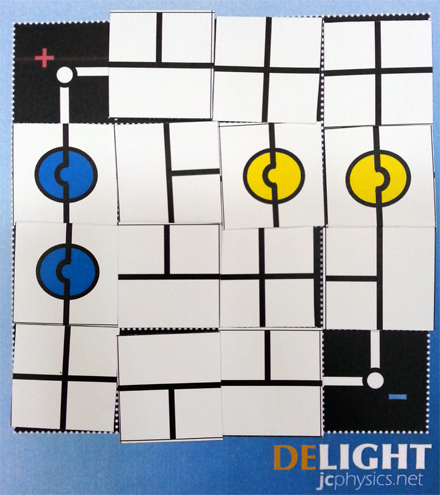
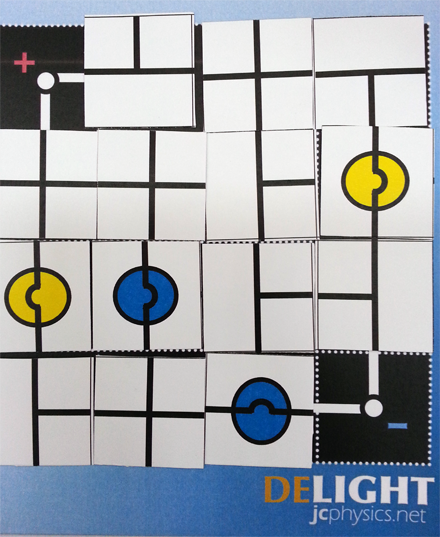
Test Yourself: Who is the winner for the games below?

GAME 1

delightend

GAME 2

gameplay2


Conditions for Using this Game

  1. Anyone can print and use this game for free as long as it is for educational or personal use. Any other reproduction or republishing of this material, in hard copy or electronic form, without written permission, is prohibited.
  2. If you would like to make a suggestion or an enquiry, please leave a comment below.